
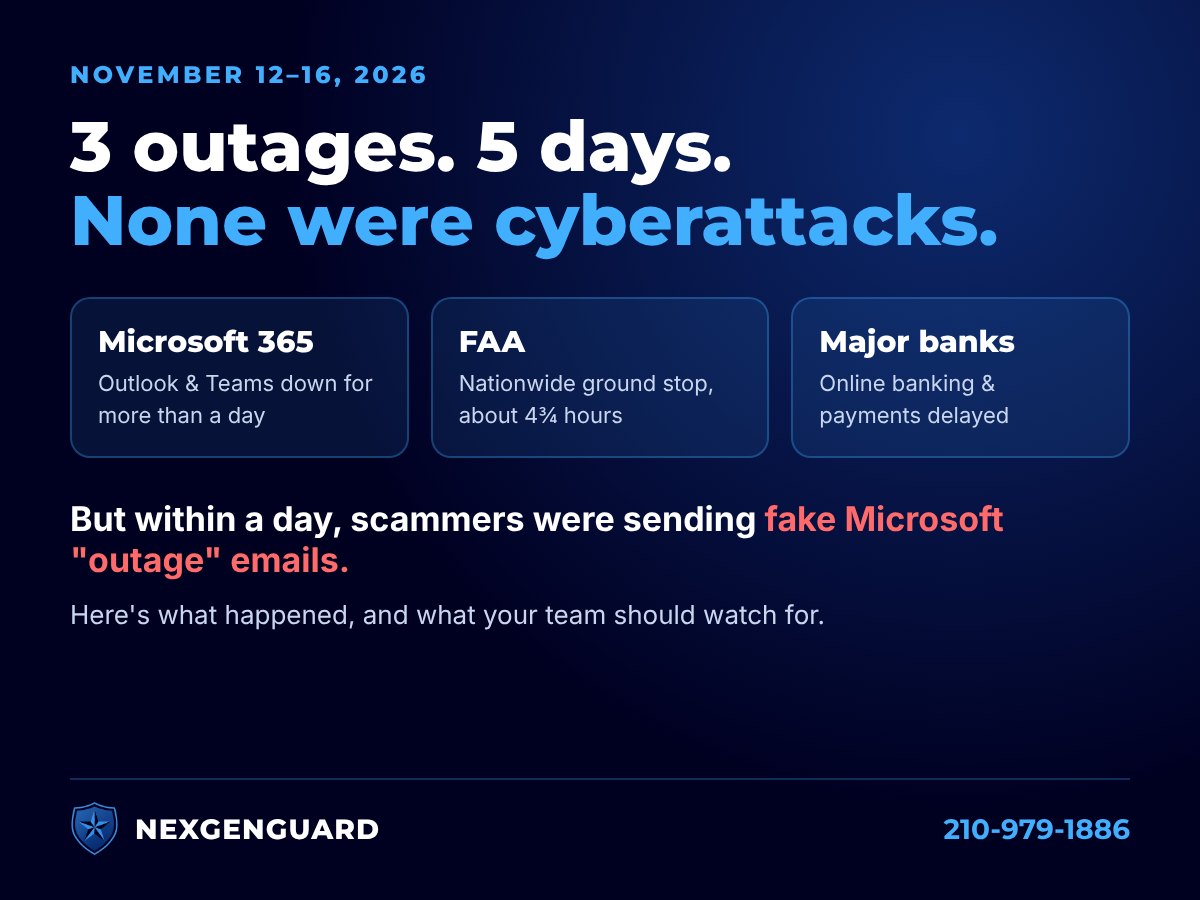
Between November 12 and 16, 2026, Microsoft 365, the FAA's air traffic system and several of the country's biggest banks all had major outages. Officials said none of them were cyberattacks. But within a day of the first one, scammers were already using it to trick people, and one of those scams reached a San Antonio business we support.
What happened
| Date | What happened | Official cause |
|---|---|---|
| Nov 12 | Microsoft 365: Outlook, Teams and other services disrupted for more than a day. Downdetector reports peaked at 48,124 in the U.S. (Forbes); disruptions were reported in 74 countries and territories (Al Jazeera). | A problem from an earlier network capacity upgrade. Microsoft: "a technical issue not related to cyber." |
| Nov 13 | FAA nationwide ground stop: about 4 hours 45 minutes, from roughly 3:30 to 8:15 p.m. ET. Operators canceled about 12,462 flights that day, though not all because of the stop (FAA). | A flood of network traffic made legacy equipment unstable; initial findings pointed to sites where a contractor was deploying a new router. FAA: "no indication that this was a cyberattack." |
| Nov 16 | Major banks: Chase drew nearly 5,000 outage reports and Wells Fargo more than 800, with problems also reported at Bank of America, U.S. Bank and Zelle (Al Jazeera). | Chase: "a technical issue, not cyber-related," and customers still had access to their accounts and funds (Fox Business). |
Lesson 1: Scammers move fast after big outages
On November 13, the day after Microsoft's outage began, Microsoft Threat Intelligence spotted a high-volume phishing campaign disguised as Microsoft 365 service-health notices. The emails claimed messages "had been held during a service disruption and would be deleted within 24 hours," with buttons like "RESTORE MESSAGES" that led to non-Microsoft websites (Microsoft Security blog). In Australia, ING warned customers that "scammers may contact you offering to resolve the Microsoft or other systems issues" (Insurance Business).
It reached San Antonio too. On November 17, one of our clients was sent an email titled "Microsoft 365 incident in the United States: reconnect your services" from "Microsoft US." The address ended in .com.pe, Peru's internet domain, not microsoft.com. It even passed the SPF, DKIM and DMARC email checks, which only prove an email came from the domain it claims, not that it came from Microsoft. Our email security quarantined it before the employee saw it.
See the real email and try to spot the warning signs →
Lesson 2: Check the real source, not the message
- Microsoft says legitimate service-health messages don't send you to non-Microsoft sites to recover mail. Check service status in the Microsoft 365 admin center, or ask your IT provider (Microsoft).
- If someone calls offering to fix an outage, hang up and call back on a number you already know is real.
- For your bank, use its app or the number on the back of your card, never a link or number from an unexpected message.
Lesson 3: Have a Plan B for email and payments
When Outlook went down, many businesses lost their main way to talk to customers. ESET's Jake Moore recommended alternative communication methods, such as phone calls, and fallback plans for when critical systems fail (Forbes). The bank outage hit closer to home: our own team had trouble making credit card payments on November 16.
- Keep a phone list of key customers, vendors and staff outside your email.
- Know how you'll pay critical bills and payroll if your bank's online services are slow.
- Make sure your important files are backed up somewhere you can reach if a cloud service is down.
Lesson 4: One change can ripple through everything
Microsoft traced its outage to an earlier network upgrade, and the FAA's initial findings pointed to a new router overwhelming older equipment. Small businesses aren't immune to the same problem: one bad update can take down a whole office. That's why updates should be tested, changes documented, and backups ready before anything goes wrong.
How we can help
NexGenGuard is a family-owned IT and cybersecurity company in San Antonio. We filter phishing like the fake Microsoft email above, train teams to spot the ones that get through, and help you plan for outages before they happen. Request a free IT security assessment or call 210-979-1886.
Sources
- Microsoft Security: High-volume phishing campaign uses Microsoft 365 outage lures (Nov 16, 2026)
- Forbes: Microsoft apologises for outage and reveals cause (Nov 13, 2026)
- Al Jazeera: Microsoft hit by global outages (Nov 13, 2026)
- FAA: Nationwide Ground Stop: Questions and Answers
- Al Jazeera: Thousands report online outages at major US banks (Nov 16, 2026)
- Fox Business: Chase systems recovering after nationwide technical outage (Nov 16, 2026)
- Insurance Business: Banks warn of outage scams (Nov 13, 2026)
